Hatter
The Hatter is one of the most memorable and philosophically unsettling characters in Wonderland, best known for hosting the mad tea-party and for his role as a witness in the trial of the Knave of Hearts. His relentless wordplay, his broken relationship with Time, and his defiant, absurd logic embody the story's central tension between childhood curiosity and the arbitrary, often threatening rules of adult authority.
Identity and Introduction
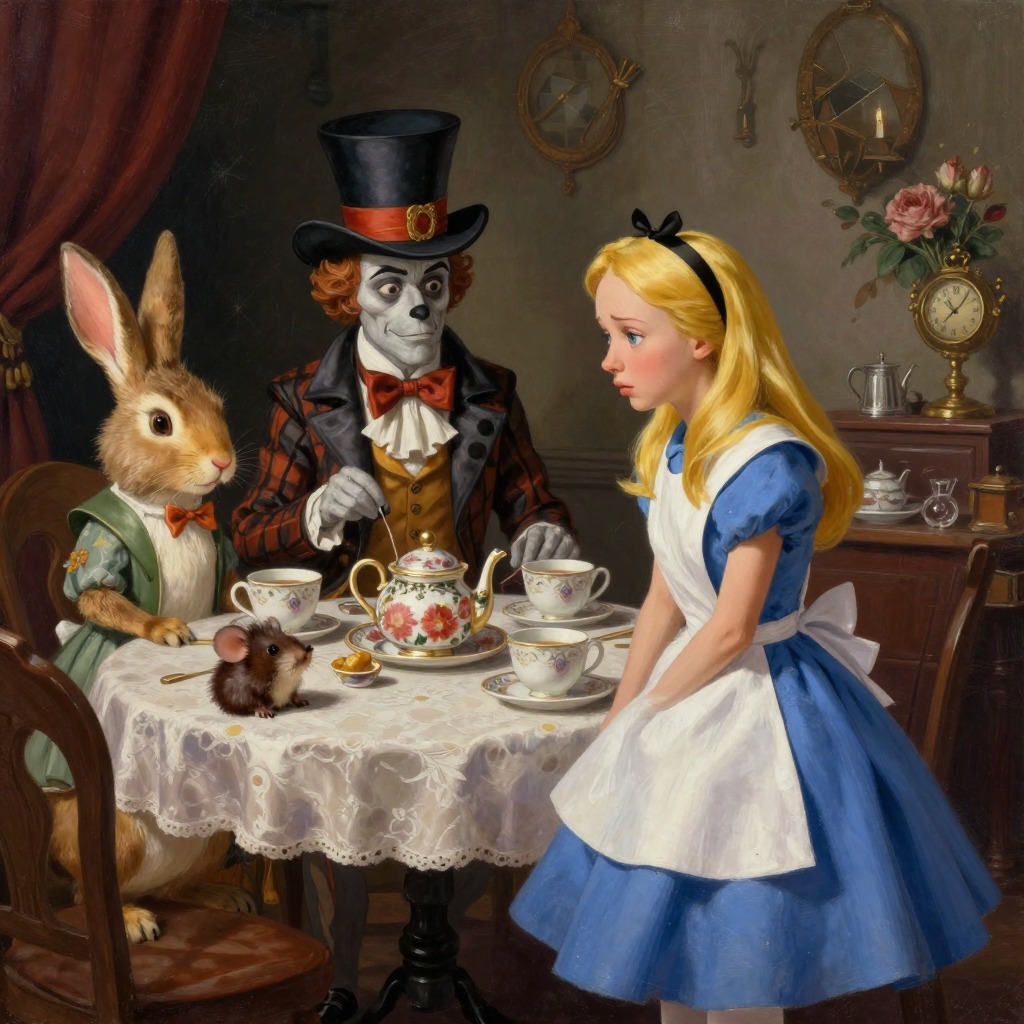
The Hatter first appears at the mad tea-party, seated at a large table under a tree outside the March Hare's house, together with the March Hare and the Dormouse. The three are crowded at one corner of the table, using the sleeping Dormouse as a cushion. When Alice approaches, they cry out "No room! No room!" despite the table being large enough for many more. The Hatter's first words to Alice are a personal remark: "Your hair wants cutting." He then immediately poses the famous riddle, "Why is a raven like a writing-desk?" establishing himself as a creature of non-sequiturs and logical traps. The Hatter is also identified as a hatter by trade, explaining to the King of Hearts during the trial that he keeps hats to sell and has none of his own.
The Mad Tea-Party and the Broken Clock
The tea-party is defined by the Hatter's quarrel with Time. He explains that he and Time quarrelled last March, just before the March Hare went mad, at a great concert given by the Queen of Hearts. The Hatter had to sing "Twinkle, twinkle, little bat!" and when the Queen heard him, she jumped up and shouted, "He's murdering the time! Off with his head!" Since that incident, Time has refused to do anything the Hatter asks, and it is perpetually six o'clock. This explains the endless tea-party: it is always tea-time, and there is no time to wash the dishes between whiles. The Hatter demonstrates his broken watch, which tells the day of the month but not the hour, and he dips it into his cup of tea in a futile attempt to fix it. The Hatter's logic is consistently circular and self-referential: when Alice says she cannot take more tea because she has had none, the Hatter retorts, "You mean you can't take less," and when Alice objects to his rudeness, he turns the accusation back on her. The party descends into a series of nonsensical stories from the Dormouse, which the Hatter and March Hare interrupt with demands to move places and change the subject. Alice eventually leaves in disgust, calling it "the stupidest tea-party I ever was at in all my life."
The Trial of the Knave of Hearts
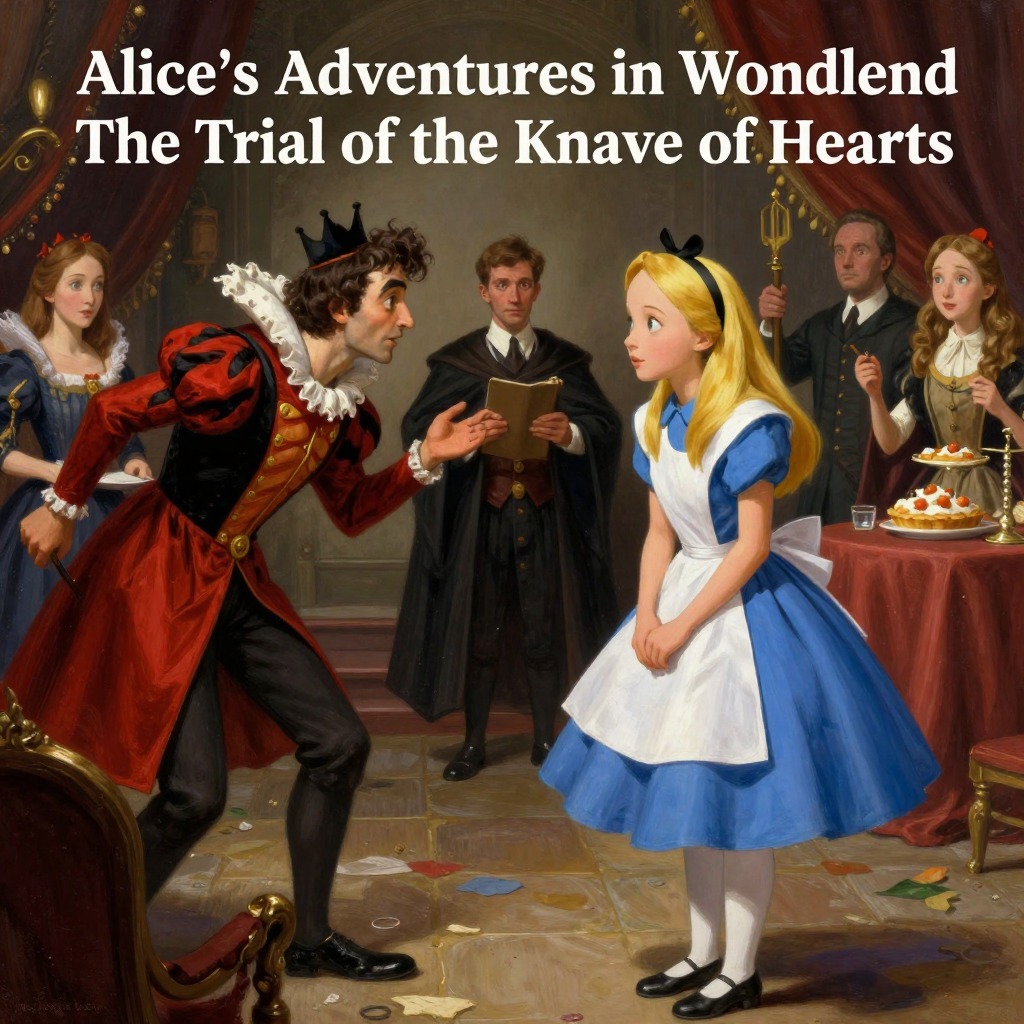
The Hatter is called as the first witness in the trial of the Knave of Hearts, who is accused of stealing the Queen of Hearts' tarts. He enters the court carrying a teacup in one hand and a piece of bread-and-butter in the other, explaining that he had not quite finished his tea when he was sent for. The King of Hearts questions him about when he began his tea, and the Hatter, the March Hare, and the Dormouse give conflicting dates: the fourteenth, fifteenth, and sixteenth of March. The King orders the jury to write down all three dates, which they do, adding them up and reducing the answer to shillings and pence. The Queen of Hearts stares at the Hatter, who turns pale and fidgets. The King warns him, "Don't be nervous, or I'll have you executed on the spot." In his confusion, the Hatter bites a large piece out of his teacup instead of the bread-and-butter. The Queen demands the list of singers from the last concert, and the Hatter trembles so violently that he shakes both his shoes off. His testimony becomes increasingly incoherent, involving the twinkling of the tea, the March Hare's denials, and the Dormouse's sleep. The King dismisses him, and the Queen orders an officer to take his head off outside, but the Hatter is out of sight before the officer can reach the door.
Language, Logic, and Thematic Significance
The Hatter is a master of linguistic subversion, using wordplay and logical paradoxes to dismantle conventional meaning. His riddle "Why is a raven like a writing-desk?" is never answered, and his arguments with Alice about saying what you mean versus meaning what you say expose the instability of language itself. The Hatter's claim that Time is a person who can be quarrelled with, and that he "won't stand beating," turns a metaphor into a literal, consequential reality. His entire existence is governed by a single, frozen moment—always six o'clock—which traps him in an endless, meaningless ritual. The Hatter's madness is not chaotic but systematic: it follows its own internal rules, which are incomprehensible to outsiders. He represents the arbitrary, often hostile nature of Wonderland's authority, where a trivial mistake in a song can lead to a death sentence, and where the most ordinary objects (a teacup, a watch) become instruments of absurdity. The Hatter's final appearance in the trial underscores the futility of seeking justice in a world where evidence is meaningless, dates are interchangeable, and the Queen's command to behead someone is treated as a routine procedural matter. Through the Hatter, Carroll explores the terrifying possibility that the rules of the world are not rational but are instead the products of mad, unaccountable whims.